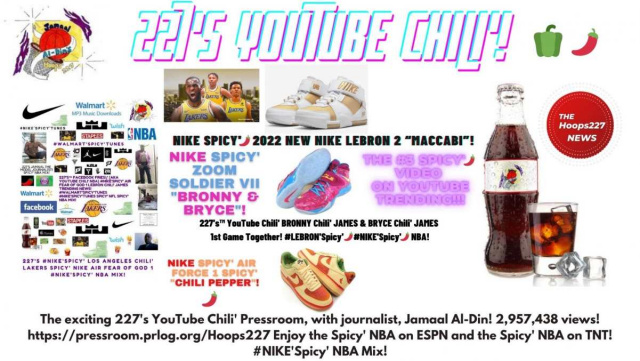
227's YouTube Chili' LeBron Chili' x Bronny Chili' x Bryce Chili' James On The Cover Of Sports Illustrated!
#LEBRON'Spicy' #NIKE'Spicy' NBA Mix!
227's YouTube Chili' RARE: LeBron Chili' James vs Mater Dei In High School In Front of 20,000 People!
#LEBRON'Spicy' #NIKE'Spicy' NBA Mix!
227's YouTube Chili' Ridiculous LeBron Chili' James High School/AAU Spicy' highlights #KingJames'Spicy' #Batman'Spicy'
#LEBRON'Spicy' #NIKE'Spicy' NBA Mix!
KHALIL Chili' SHAKIR #SHAK'Spicy' is on pace to complete his career as the Boise State Chili' Broncos 5th all-time leader in receptions! #NIKE'Spicy' NFL Mix!
KHALIL Chili' SHAKIR #SHAK'Spicy' is being compared to former Spicy' NFL Pittsburgh Chili' Steelers great, HINES Chili' WARD! (2× Super Bowl champion XL, XLIII, 4× Pro Bowl) #NIKE'Spicy' NFL Mix!
Jamaal Al-Din's Hoops 227 (227's YouTube "Chili"), in Boise, Idaho
- Home of the 2007 & 2010 Tostitos Fiesta Bowl Champions - Boise State Chili' Broncos!
Sean Kingston- "Beautiful Girls" at 227's YouTube "Chili!" Your source for the world's most watched entertainment and music videos from YouTube at Jamaal Al-Din's Hoops 227- the everything basketball website!
227's NBA Fact: The NBA's Kobe Bryant (Los Angeles Lakers) entered the National Basketball Association right after high-school and has worn two jersey numbers during his professional basketball career: 8 & 24.
Girlicious YouTube Video featuring Sean Kinston at 227's Utube "Chili!"
227's NBA Fact: Shaquille O'Neal of the NBA's Phoenix Suns has played for 4 teams in the NBA: Orlando Magic, Miami Heat, Los Angeles Lakers and Phoenix Suns.
Beyonce' Knowles at 227's U Tube "Chili!" Your source for the world's most watched YouTube Music and entertainment Videos on Jamaal Al-Din's Hoops 227- the everything basketball website!
227's NBA Fact: Kevin Garnett of the 2007-08 NBA World Champion- Boston Celtics began his career with the Minnesota Timberwolves and was drafted right out of high-school.
Madonna's Special Message to her YouTube Fans all over the world! 227's YouTube "CHILI!" recognizes www.madonna.com and encourages fans to purchase albums from her creative website including her new album..."Hard Candy!"
227's NBA Fact: The Detroit Pistons' Tayshaun Prince is a member of the 2008 USA Men's Olympic Basketball Team. He attended the University of Kentucky in Lexington, Kentucky.
Jonas Brothers-"Burnin Up" at 227's UTube "Chili!" Purchase "Burnin Up" at iTunes!
227's NBA Fact: Madison Square Garden of New York City, home of the NBA's New York Knicks is home of some of the most memorable music concerts and legendary Muhammad Ali fights!
Lil' Wayne feat. T-Pain & Mack Maine!- "Got Money" at 227's YouTube "CHILI!"
227's NBA Fact: The Miami Heat's Dwayne Wade is a perennial NBA All-Star guard who lead the Miami Heat to their 1st NBA World Championship over the Dallas Mavericks.
Pop music From Wikipedia, the free encyclopedia Jump to: navigation, search This article may require cleanup to meet Wikipedia's quality standards. Please improve this article if you can. (June 2008) Pop Stylistic origins March music Folk Ragtime Cultural origins 1911, United Kingdom and United States. Typical instruments Electric guitar - Bass guitar - Drum kit - Synthesizer - Keyboard - Drum machine - Sequencer - Sampler - Vocals Mainstream popularity Continuous worldwide since emergence. Subgenres Baroque pop - Bastard pop - Bubblegum pop - Dance-pop - Girly-pop - Disco - Indie pop - Manufactured pop - Noise pop - Operatic pop - Power pop - Sophisti-pop - Space age pop - Sunshine pop - Synthpop - Teen pop Fusion genres Country pop - Dream pop - Electropop/Technopop- House-pop - Jangle pop - Pop folk - Pop punk - Pop rap - Pop rock - Psychedelic pop - Urban pop Regional scenes Africa: Afropop Americas: Brazilian pop, Latin pop, Mexican pop, Louisiana swamp pop, US pop Asia: Arab pop, Arabesque, Chinese pop, Filmi, Hindi pop, Hong Kong and Cantonese pop, Hong Kong English pop, Indonesian pop, Japanese pop, Korean pop, Mandarin pop, Persian pop, Taiwanese pop, Thai pop, Turkish pop Europe: Austropop, Britpop, Disco polo, Eurobeat, Euro disco, Europop, French pop, Greek Laïkó pop, Italo dance, Italo disco, Levenslied, Nederpop, Russian pop, Schlager, Vispop, Yugoslav pop Other topics Pop culture - Pop duo - Boy band - Girl group - Pop icon Music portal This article is about the genre of popular music. For the song by M, see Pop Muzik. For other uses, see Pop music (disambiguation). Pop music will have a noticeable rhythmic element, catchy melodies and hooks, a mainstream style and traditional structure. However pop can also just be music charted by the number or sales, plays, etc., that the work receives. In opposition to music that may require education or formation to fully appreciate, a defining characteristic of pop music is that anyone is able to enjoy it. Artistic concepts such as musical form and aesthetics are not a concern in the writing of pop songs, the primary objectives being audience enjoyment and commercial success.[1] Although pop music is usually produced with a desire to sell records and do well in the charts, it does not necessitate wide acclaim or commercial success: there are bad or failed pop songs.[2] Initially the term was an abbreviation of, and synonymous with, popular music, but evolved around the 1950s to describe a specific musical category.[3] Contents [hide] 1 Current genres 1.1 United Kingdom 1.2 United States 2 Characteristics 3 History 4 Evolution 4.1 1911 4.2 1950s 4.3 1960s 4.4 1970s 4.5 1980s 4.6 1990s 4.7 2000 to the present day 5 Top-selling pop artists 6 References 7 See also 8 Bibliography 9 External links
Current genres Musicologists identify a tendency in society for individuals to set the music of themselves and their peers apart from that of other groups with a self-proclaimed genre of music.[4] This tendency has resulted in an almost unlimited list of names for styles of music,[5] and no possible method to define them all.[6] Recording labels cater to these perceptions placing their product in outlets under a number of different categories.[7] However, due to market requirements, in commercial popular music there is in reality only a limited number of genres. Market statistical models require a certain amount of stability but societal changes and technical advancements do drive change.[8] The last major change in music categories occurred in 1991.[9] These are the current popular music genres: United Kingdom UK R&B[10] UK Dance[11] UK Rock[12] UK Independent[13] UK Country[14] UK Jazz[15] UK Blues[16] UK Classical[17] UK Sountrack[18] UK Spoken Word[19] United States Hot/Pop[20] Digital & Mobile[21] Historical[22] R&B/Hip-Hop[23] Country[24] Latin[25] Rock[26] Adult Contemporary[27] Heatseekers/Independent[28] Christian/Gospel[29] Dance/Electronic[30] Classical/Jazz[31] International[32] Video[33] Boxscore[34] Characteristics The standard format of pop music is the song, customarily less than five minutes in duration, and with an instrumentation that can range from an orchestra to a lone singer. Despite this wide scope, a typical lineup in a pop band includes a lead guitarist, a bassist, a drummer (or an electronic drum machine), a keyboardist and one or more singers, who may or may not themselves be instrumentalists. Pop songs are generally marked by a consistent and noticeable rhythmic element, a mainstream style and traditional structure. The most common variant is strophic in form and focuses on melodies, catchy hooks and the appeal of the verse-chorus-verse arrangement, with the chorus sharply contrasting the verse melodically, rhythmically and harmonically.[35] Some of the most common themes in pop music are romantic love and feelings. Pop music often uses the technique of taking themes from other records producing a satirical or self-referential mixture of past styles. It also employs techniques of sampling and sequencing to introduce individuality and creativity. History The origins of pop music can be traced back in Napoli, Italy, in 1679, when Alessandro Scarlatti composed his first opera, or even earlier, when Francesco Provenzale coined the musical language that Scarlatti popularized: light, lively and catchy. They placed the emphasis on arias, clearly separated from the "recitativo", and grounded the arias on a strong sense of rhythm and melody. The chain began with the end of the Speed War, a battle between the labels of the day to enforce their own standard. The dominating format, the 10 inches (25 cm) 78 revolutions per minute (rpm) disc, was challenged in 1948 by the new 33 ⅓ rpm 12 inches (30 cm), and then in 1949 by the 45 rpm 7 inches (18 cm).[36][37] Next came the switch in the material records were made of, from shellac to vinyl;[38] the new component, combined with the slow 33 ⅓ rpm playing speed, allowed recordings to extend their duration further than was previously possible, and gave birth to the long playing record (LP).[39] Changes continued with the invention of the multitrack tape recorder, permitting completely electronic studio recordings for the first time, and the advent of stereophonic sound in 1958.[40][41] These technical advances brought about a recorded music that was standardised, of better quality than ever before, and most importantly, easier and less costly to produce, which meant it could be offered to the public at consistently lower prices. In just one year, 1954 to 1955, the average selling price of an LP in the US dropped from US$5.95 to $3.98.[42][43] Cheaper records led to greater demand for record players, which in turn became less expensive and continued to boost sales. These changes in sound recording, coupled with the improved economic circumstances of the era, led the general public to purchase records like never before. Music ceased to be a minority ware with limited following and became a mass-market commodity with an enormous audience. The new financial prospects and opportunities for secure investment attracted capital, which began applying commercial merchandising techniques to music: advertising, tie-ins, cross-media marketing and others. The most infamous of these is the payola, whereby record labels pay radio stations or disc jockeys to play particular songs, artificially influencing their popularity. The emerging role of investors in the music industry led to tensions between the creative and the productive sides of the business, with the former accusing the latter of excessive concern with commercial success. In many cases the artists won and retained the idiosyncrasies of their style. Pop did not have as easy a start in the United Kingdom as in the US due to intense regulation of radio play, known in the day as needle time. This legislation required the BBC, the only broadcaster legally allowed to play music, to do so for only a few hours a day for fear of damaging the revenues of the music industry by allowing the public to hear songs without purchasing them.[44][45] The ordinance lasted until the launch of Radio 1 in 1967. Evolution This article or section deals primarily with the United States and does not represent a worldwide view of the subject. Please improve this article or discuss the issue on the talk page. In contrast to genres with clear origins and a traceable evolution, pop developed, and continues to expand, as a haphazard merging of styles. Pop is an amalgam of successive fashions, of elements of many differing styles that have been successful over the years and have ended up incorporated into the genre.
This section introduces the most significant tunes of each decade, and shows the progression of pop to its current form. Because performers of all varieties have released tracks that can be classified as pop, this article analyses songs, and does not list names of acts, bands, musicians or singers. For these please see the List of artists who reached number one on the Hot 100 (U.S.), List of artists who reached number one on the UK Singles Chart and List of artists by total number of U.S. number-one singles. 1911 Most Music Historians agree that the first Pop song was Alexander's Ragtime Band by Irving Berlin in 1911. To fully comprehend the significance of Alexander's, you have to understand that this song had a presence on the charts for five straight decades. According to Newsweek Magazine, * 4 different versions of the tune charted at # 1, # 2, # 3 and # 4 in 1911. * Bessie Smith's version made the top 20 in 1927. * Louis Armstrong made the top 20 with it in 1937. * A duet by Bing Crosby and Connee Boswell hit #1 in 1938. * Johnny Mercer charted a swing version in 1945. * Bing Crosby recorded another duet version, and hit the top-20 in 1947 with Al Jolson. * Nellie Lutcher put it on the R&B charts in 1948. * Bob Wills put it on the c&w charts in the same decade. * Ella Fitzgerald scored with it in 1958, and received a Grammy for her Irving Berlin anthology in 1959. Because Berlin was a Tin Pan Alley composer at the time, it is likely that others preceded him in blending styles into a more approachable, popular sound. Perhaps, but certainly Alexander's Ragtime Band was the first to do it successfully. Survey 100 musical historians and you may get a number of different answers, but the overwhelming majority will agree, this was the beginning of the pop idiom. 1950s Start of the 50s songs who belong to Pop were crossover styles from the standard formats of the day. In country music, instrumental soloing was de-emphasised and more prominent vocals added, commonly backed by a string section and vocal chorus, as exemplified in "(How Much Is) That Doggie In The Window", which became a hit in both the US and the UK in 1953. Two years later American folk music entered the pop spectrum with a modern version of a traditional tune, "The Yellow Rose of Texas" (1955). Vocal performers of the great American songbook classics, crooners and big band singers, incorporated elements of other styles and orchestral enhancements to their repertoire, giving them greater formal complexity than their traditional antecedents. The Marc Blitzstein arrangement of "Mack the Knife" is an emblematic example, topping the charts on both sides of the Atlantic in 1954, as did "Singing the Blues" in late 1956 and early 1957. This was also the decade of the advent of rock and roll, a massively influential genre that spawned innumerable changes in the social and cultural fabric of the US, and subsequently the World. The convulsion began when "Rock Around the Clock" crowned the charts in the spring and summer of 1955, and continued with "Heartbreak Hotel" in 1956 and "All Shook Up" in 1957. Previously regional or niche formats became mainstream for the first time, some going on to become genres in their own right. Latin music entered the general consciousness with "Cherry Pink (and Apple Blossom White)" in 1955, and Italian popular music with "Nel blu dipinto di blu" in 1958. 1960s The decade kicked off a style that is still recorded today, the novelty song, combining humorous or parodic lyrics and simple, catchy melodies: "Itsy Bitsy Teenie Weenie Yellow Polka Dot Bikini" (1960). In 1961 a new format arose around close vocal harmonies and lyrics reflecting the Californian relationship with surfing, girls and cars: Surf pop. This very successful style is epitomised by tunes like "Surfin' USA" (1963), "California Girls" (1965) and "Good Vibrations" (1966). An unusual combination of minor chords and an unexpected synthesizer formed the basis of one of the greatest hits of the first half of the decade, "Runaway" (1961), whilst in the second half a four-note electric bass riff offsetting a simple melodic arrangement brought commercial and critical success to "Windy" (1967).
The music that had radiated from the US to the rest of the World in the previous decade bounced back in this one, bringing with it nuances, variations and completely new styles. In the United Kingdom teens developed a feel for rock and roll and the blues, blending them with local traditions like skiffle and giving rise to music they could relate to and perform with conviction. Youths with electric guitars began joining beat bands and writing and playing up-tempo melodic pop. Some of these enjoyed success only in Europe ("Apache" (1960), "The Young Ones" (1962), "Keep On Running" (1965) and "Where Do You Go To (My Lovely)" (1969)), as others crossed the Atlantic and became the British invasion (1964 to 1967), delivering a whole new range of influences to US pop with songs like "I Want to Hold Your Hand", "Can't Buy Me Love" and "Downtown" (all 1964), "Yesterday" (1965), "Yellow Submarine" (1966), "To Sir, with Love" (1967), "Hey Jude" (1968) and "Get Back" (1969). African American music broke into popular culture in a big way in this decade, bringing with it new grooves and tempos, such as doo-wop, a style giving prevalence to melody-dominated homophony and vocal-based harmonies; rhythm and blues, a combination of jazz, gospel and blues; Motown, soul music with a prominent and melodic bass line, a distinctive chord structure and a call-and-response singing style: "I Can't Stop Loving You" (1962) "He's So Fine" (1963) "Hello Dolly!" (1964) "Baby Love" (1964) "Reach Out I'll Be There" (1966) "Respect" (1968) "(Sittin' on) the Dock of the Bay" (1968) "I Can't Get Next to You" (1969) Producers' involvement in the business reached new levels in 1965 when Raybert Productions set out to create a pop band from scratch, selecting the members by their looks, dancing ability and appeal to different personalities of fan, rather than musical prowess. The company controlled every aspect of the group, from choice of music to individual behaviours, and guided them to extraordinary success in music, television and cinema. This type of prefabricated band was termed manufactured pop and is the precursor of boy bands and girl groups. The greatest hit by the original act was "I'm a Believer" (1967), followed shortly after by a number one from the second of these manufactured groups, "Sugar, Sugar" in 1969. 1970s Singer-songwriters and other folk-based artists were the biggest contributors to the pop genre in the first half of this decade, from 1970's "Bridge over Troubled Water" and "(They Long to Be) Close to You"(although this was not actually a singer-songwriter effort, but a was written by one of the last remnants of the Tin-Pan-Alley/Brill Building days, Burt Bacharach and Hal David), through 1971's "It's Too Late", to 1972's "American Pie", "Alone Again (Naturally)" and "Without You". The main influence in the second half of the decade came from disco, a dance-oriented style with soaring, reverberated vocals, a steady beat and prominent, syncopated electric bass lines: "Disco Lady" and "Play That Funky Music" (both 1976), "I Just Want to Be Your Everything" (1977), "Night Fever" and
"Stayin' Alive" (both 1978), "Bad Girls", "Le Freak" and "YMCA" (all 1979). Country music re-entered pop in 1973 with "Tie a Yellow Ribbon Round the Ole Oak Tree" and in 1975 with "Rhinestone Cowboy", whilst the African American rhythms that had so affected the genre in the previous decade were still producing hits and expanding limits in this one. Disco, an almost entirely African American creation, was joined in the charts by protest songs ("War" (1970)), soulful ballads ("The First Time Ever I Saw Your Face" (1972), "Killing Me Softly with His Song" and "Let's Get It On" (both 1973)), and by more upbeat compositions ("Best of My Love" (1977)). Sounds from the UK continued to permeate pop music, with pop rock songs like "Maggie May" (1971), "Da Ya Think I'm Sexy?" (1978) and "My Sharona" (1979); blues-based tunes in the style of "In the Summertime" (1970); and simple pop ditties such as "Save Your Kisses for Me" (1976) "Don't Go Breaking My Heart" and "Silly Love Songs" (both 1979). In the same way that Britain contributed to the genre since the 1960s, pop artists started appearing in other nations in the 1970s, some with surprising longevity and significance. Special mention must go to Sweden for ABBA who took over the music world with songs like "Waterloo" (1974), "Fernando" (1976), "Take a Chance on Me" (1978), "Dancing Queen", "The Name Of The Game" and to Boney M for the hits "Daddy Cool" (1976), "Ma Baker" (1977) and "Rivers of Babylon" (1978). 1980s The mutual benefits the film and music industries could afford each other were evidenced in this decade by the songs from movie soundtracks that became chart-toppers: "Eye of the Tiger", from 1982's Rocky III; "Flashdance... What a Feeling", from Flashdance (1983); "Footloose" from the eponymous 1983 film; "Against All Odds (Take a Look at Me Now)" from 1984's Against All Odds; "Into the Groove" from 1985's Desperately Seeking Susan; and "Say You, Say Me", out of the 1985 blockbuster White Nights. The return influences of pop were having a greater impact in this decade than ever before. Hits in the US charts came from the UK, "Careless Whisper", "Wake Me Up Before You Go Go" (both 1984), "Faith" (1987), "Got My Mind Set on You" and "Never Gonna Give You Up" (both 1988); and from Australia, "Need You Tonight" (1987). The rock genre delivered a good number of pop hits this decade, with bands otherwise protective of their roots delving briefly into commercialism. See "I Love Rock 'n' Roll" (1982), "Centerfold", "Every Breath You Take" (both 1983), "Down under" (1983, also from Australia), "I Want to Know What Love Is" (1985) and "Sweet Child o' Mine" (1988). Producers wishing to multiply their markets tried bringing two accomplished acts together, aggregating the fans of one to those of the other. The concept worked, and the following combinations became hits: "Endless Love" (1981), "Ebony and Ivory" (1982), "Say Say Say" (1983) and "On My Own" (1986). Pop music came of age in this decade, crowning its own King and Queen ( Michael Jackson and Madonna ) of the popular music, rock artists that left behind them histories with other styles and devoted themselves wholeheartedly to, or began whole careers in, rock music. Primary examples are "Rock with You" (1980), "Billie Jean", "Beat It" (both 1983), "Borderline," "Like a Virgin" (both 1984), "Papa Don't Preach" (1986), "Bad" (1987), "Dirty Diana" (1988) and "Like a Prayer" (1989). The African American influence reached new heights with songs like "What's Love Got to Do with It?" and "I Feel for You" in 1984, "What Have You Done For Me Lately?" and "When I Think Of You" in 1986, "Shake You Down" and "I Wanna Dance with Somebody (Who Loves Me)" in 1987, "My Prerogative" in 1988, and "Miss You Much" in 1989. A new kind of release debuted in this decade, the charity record, aimed at raising funds for a particular cause held dear by the performer(s). The first of these came from the United Kingdom in 1984, "Do They Know It's Christmas?", followed in 1985 by "We Are the World", and by "That's What Friends Are For" in 1986. 1990s The early 1990s saw the popularity of the Stock Aitken Waterman sound begin to fade, after the team of producers had a string of UK hits in the late 1980s. One of the big trends in UK pop music this decade was the boy band and girl band, with early successes being Manchester's Take That and Ireland's Boyzone. The Spice Girls had their first hits in 1996 and dominated the next few years with many hit singles, and by the end of the decade there were many others, from boybands Westlife and Five to girlbands B*Witched and All Saints. Many popular songs came from female artists. A few of the most significant are "Hold On", "Nothing Compares 2 U" "Better the Devil You Know","Hold On" and "Vogue" (all 1990), "The Shoop Shoop Song" (Cher version) and "Rush Rush" (all 1991), "Save the Best for Last", "I Will Always Love You" (all 1992), "The Power of Love" , "That's The Way Love Goes" and "Hero" (all three from 1993), "Creep" (1994), "Waterfalls" (1995), "Wannabe (1996)" and "Always Be My Baby", "You Were Meant for Me" (all 1996), "How Do I Live" (1997), "Frozen", "Ray of Light", "Believe" and "The Boy Is Mine" (all 1998), and "...Baby One More Time", "Genie in a Bottle", "Maria" and "Have You Ever?" (all 1999). Following-up on the positive results of the eighties, songs from movie soundtracks continued to be popular. Defining hits of the genre include "It Must Have Been Love" from 1990's Pretty Woman; "I Wanna Sex You Up" from New Jack City and "(Everything I Do) I Do It for You" from Robin Hood: Prince of Thieves (both 1991); "End of the Road" from Boomerang and "I Will Always Love You" from The Bodyguard (both 1992); "Can't Help Falling in Love" from 1993's Sliver; "Gangsta's Paradise" from Dangerous Minds and Kiss from a Rose from Batman Forever (both 1995); Don't Let Go from Set It Off (1996) and "My Heart Will Go On" from Titanic (1998). Dance music broke out of a specialised section of the market into pop in this decade, with hits such as "Gonna Make You Sweat (Everybody Dance Now)" (1990) and "Saturday Night" (1994). Simultaneously, African American influences continued with rock, rhythm and blues and hip hop-inspired tunes. Indicative examples of the first are "Black or White" (1991) and "You Are Not Alone" (1995), notable instances of the second being "Baby Got Back" and "Jump" (both 1992), "On Bended Knee" and "I'll Make Love to You" (both 1994), and "I'll Be Missing You" and "Can't Nobody Hold Me Down" (both 1997).
Coolio's 1995 single "Gangsta's Paradise" became the first rap song to sell a million copies in the UK. Pop became truly international in the nineties, with hits coming from diverse and distant locations: Germany, "The Power" (1990), "Rhythm Is a Dancer" (1992) and "Mr Vain" (1993); the UK, "The One and Only" (1991), "Ebeneezer Goode" (1992), "Things Can Only Get Better" and "Love Is All Around" (both 1994), "Spaceman" (1996), plus one of the best selling singles of all time, "Candle in the Wind 1997"; Other British success was of the Spice Girls who have since become Pop icons, with Global hits such as "Wannabe" and "2 Become 1". United States, "...Baby One More Time" (1999) Spain, "Macarena" (1996); Italy, "Blue (Da Ba Dee)" (1999); The Netherlands", "Boom Boom Boom Boom" (1998); and "We Like to Party" Australia, "Confide in Me" (1994), "Torn" (1997), "Truly Madly Deeply" (1998) Latin Pop, "Media Naranja" "Estoy Aqui" Ireland: "Flying Without Wings" (1999) Turkey: " Şımarık" " Tarkan " (1999) [edit] 2000 to the present day In a similar vein to the previous decade, female singers have had a big influence on the pop music in the first decade of the twenty-first century, with rhythmic ballads, hip hop pieces and dance tracks: "Music" (2000); "Fallin'", "All for You" and "Whenever, Wherever" (all 2001); "Foolish", "What about Us?", "Beautiful", "I Begin To Wonder", "Murder on the Dancefloor" and "Can't Get You Out Of My Head"(all 2002); "Crazy in Love" and "White Flag", "Superstar", "Scandalous" (all 2003); "Goodies", "If I Ain't Got You", "1, 2 Step", " Toxic", "Afrodisiac", "Since U Been Gone", "Come Clean", "Slow" (all 2004); "Hips Don't Lie", "Hollaback Girl" , Hung Up and "We Belong Together" (all 2005);"Irreplaceable" and "Say It Right" (all 2006); "The Sweet Escape", "Promiscuous", "With Love", "Umbrella" and "Gimme More" (all 2007); "In My Arms", "Piece of Me", "Take a Bow", and "Disturbia" (all 2008). Many children's or 'kids' music groups fall generally under the title of 'pop music'. A group such as 'The Jonas Brothers' is an example fo this. Traditional rock and modern rock made forays into pop with consecrated artists and newcomers both introducing songs to the pop music: "Smooth", "Maria Maria" and "It's My Life" (all 2000), "Drops of Jupiter (Tell Me)", "Hanging By A Moment" and "Stuck in a Moment You Can't Get Out Of" (both 2001), "This Love" (2003), and "Boulevard of Broken Dreams" (2005). Entirely digital productions integrated new technology and sounds, and as electronic dance music entered the mainstream, pop artists started using producers and remixers who contributed their styles to the genre: "Feel Good Inc." (2005) and "Crazy" (2006) are good examples. Once more, African Americans contributed heartily to pop with diverse styles. Some hits were hip hop-based, such as "Hot in Herre" and "Dilemma" (both 2002), "In da Club" and "Ignition" (both 2003), "Yeah!" and "Goodies" (both 2004), "Candy Shop" and "Don't Phunk with My Heart" (both 2005). Other chart-toppers were variations on reggae beats ("It Wasn't Me" (2000) and "Get Busy" (2003) or more traditional rap compositions such as "The Way You Move" (2003). The international appeal of pop was evident in the new millennium, with artists from around the world influencing the genre and local variants merging with the mainstream. Russia made its breakthrough to the international charts with "All the Things She Said" (2002) which even topped the UK Singles Chart. Latin pop was successful with songs from Spain, "Hero", "Escape", (late 2001/early 2002), "The Ketchup Song" (2002); Mexico,"Rebelde" (2004) and Colombia, "Whenever, Wherever", "Underneath Your Clothes", (2002) and "Hips Don't Lie" (2006). Irish entered the bharts with Westlife hits: "Fool Again" and "My Love" (2000), "Uptown Girl" and "Queen of My Heart" (2001), "Bop Bop Baby", "World Of Our Own", and "Unbreakable" (2002), "Mandy" (2003), "You Raise Me Up" (2005). Canada entered the charts with "That's the Way It Is" (2000). British artists did the same with "Feel" (2003); "You're Beautiful" (2005); "You Give Me Something" (2006) and "Rehab" (both 2006); "Smile";"Tell Me 'Bout It" and "Bleeding Love" (all 2007). Moldova hit the European charts with "Dragostea din Tei" (2003), "Despre tine" (2004); and Romania did with "Kylie" (2005). Australia reentered the global pop scene with the mainstream return of superstar Kylie Minogue whose single "Can't Get You Out Of My Head" was number 1 in 40+ countries. Australia also saw other success stories with Natalie Imbruglia, Delta Goodrem, Holly Valance and Dannii Minogue. Top-selling pop artists Artist Records sold Genre Albums Years active 1. Michael Jackson 350 million + Pop 20 1967–present 2. Bee Gees 300 million + Pop/Rock/Soul/RnB/Country/Disco 29 1958–present 3. Madonna 295 million + Pop/Dance 21 1982–present 4. Cher 275 million + Pop/Dance/Rock 25 1964 – present 5. Elton John 250 million + Pop/ Pop rock 56 1964 – present 6. Celine Dion 215 million + Pop 45 1982–present 7. Julio Iglesias 200 million + Pop Latin 77 1968–present 8. Mariah Carey 190 million + Pop R&B 11 1991–present 9. Whitney Houston 170 million + Pop 14 1985–present 10. ABBA 160 million + Pop 33 1972–1982 11. Janet Jackson 130 million + R&B Pop 11 1982 – present 12. Barbra Streisand 100 million + Pop 60 1957 – present 13. Backstreet Boys 100 million + Pop 7 1993–present 14. George Michael 100 million + Pop Soul 8 1981–present 15. The Jacksons 100 million + Pop 19 1966 – 1990 16. Britney Spears 88 million + Pop 7 1998 – present 17. Robbie Williams 70 million + Pop 13 1990 – present 18. New Kids On The Block 70 million + Pop 8 1984–1994, 2008–present 19. Kylie Minogue 68 million + Pop 21 1987–present 20. Spice Girls 57 million + Pop 4 1996–2001, 2007–2008 21. 'N Sync 56 million + Pop 5 1997 – 2002 22. Ricky Martin 55 million + Pop Latin 12 1984–present 23. Shakira 50 million + Pop Latin 11 1991 – present References ^ Hill, D. (1986). Designer Boys and Material Girls: Manufacturing the 80's Pop Dream. Blandford Press. “Pop implies a very different set of values to rock. Pop makes no bones about being a mainstream. It accepts and embraces the requirement to be instantly pleasing and to make a pretty picture of itself. Rock, on the other hand, has liked to think it was somehow more profound, non-conformist, self-directed and intelligentyahoo.com.” ^ "United Kingdom Broadcasting Act 1990 — Part III, chapter I, article 85, point 6" (html). Retrieved on 2007-12-01. “Pop music includes rock music and other kinds of modern popular music which are characterised by a strong rhythmic element and a reliance on electronic amplification for their performance (whether or not, in the case of any particular piece of rock or other such music, the music in question enjoys a current popularity as measured by the number of recordings sold)” ^ "Online Etymology Dictionary: pop" (html). Retrieved on 2007-12-01. ^ Johnson, Who Needs Classical Music??, p. 44: "Today, identification with a certain kind of music is often inseparable from identification with a singer or group and this with a larger network of signs that collectively define a wider cultural position. In contemporary commercial music this cultural position is fundamentally allied to a statement of fashion position: a definition of how one is placed within contemporary fashion." ^ Bell, The Singing Thing, p. 40: "More than ever before, the tribal factor is evident in contemporary commercial music. Indeed, one has difficulty in finding a blanket term for this entity. Pop and rock are now specialist rather than general categories.
They take their place alongside rap, acid house, funk and a dozen others, all of which have their own devotees." ^ Shuker, Popular Music, p. xii: "The diversity of popular music genres is indicative of the difficulties of defining popular music in any succinct and broadly acceptable manner. Genres defy static, academic definition indpendent of those making and listening to the music." ^ Frith, The Cambridge Companion to Pop and Rock, p. 35: "The other way in which the music industry seeks to bring order to the music market is in the use of genre lables. Pop music marketing has always meant marketing different types of music to different types of consumer. The is most obvious in the lay out of record shops; discs are racked a rock, country, dance, rap, raggae, world music in miniature, with its own magaznes, radio programmes, live venues and specialist shops and web sites. As Keith Negus has shown, far from record companies imposing a single corporate culture on the worlds, they see, rather, to accommodate the different ways in which different musics are used by different audiences. Each record company division—rock, salsa, country, rap—has its own commercial and cultural character." ^ Negus, Music Genres and Corporate Cultures, p. 14: "A central theme of this book is the idea that and industry produces culture and culture produces and industry." ^ Watkins, Hip Hop Matters, p. 44-45: "Before SoundScan [1991] pop was largely defined by aesthetic attributes—sweet melodies, stylistic conservatism, and amicable lyrics. After SoundScan pop was just as likely to be defined by economics and marketplace resonance. The focus in this instance was on weekly sales figures and dollars. under the latter definition, it became necessary to expand how the industry and the culture defined and experienced pop music. the shift meant tha genres such as rap, despite an emotional and aesthetic core that ran couter to tradition, could now be added to the pop mix."
^ Official UK Charts Company ^ Billboard Genre Index ^ "Allmusic genres: pop" (html). Retrieved on 2007-12-01. ^ "Billboard history — War of the speeds" (html). Retrieved on 2007-12-01. ^ "Gramophone records — Speeds" (html). Retrieved on 2007-12-01. ^ "Gramophone records — Materials" (html). Retrieved on 2007-12-01. ^ "LP album" (html). Retrieved on 2007-12-01. ^ "History of multitrack recording" (html). Retrieved on 2007-12-01. ^ "Stereophonic sound" (html). Retrieved on 2007-12-01. ^ "Chronomedia, 1954" (html). Retrieved on 2007-12-01. ^ "Chronomedia, 1955" (html). Retrieved on 2007-12-01. ^ "Even pirates have their day" (html). Retrieved on 2007-12-24. “In Britain, however, 20-plus years after the end of WWII, they didn’t even have Top 40. Music broadcast was limited to the BBC and for only part of the day. The BBC's lack of music programming was the result of what was called needle time, which prevented the playing of records over the air for more than a set length of time per day. Needle time, it was thought, would keep the unionized musicians employed, while the record companies believed it would prevent the loss of record sales due to the ability to listen for free over the airwaves.” ^ "John Peel biography — 1967 Part One" (html). Retrieved on 2007-12-24. “The BBC also had to play a certain amount of live music, according to the Musicians' Union, to ensure that performing musicians could make a living. This was called the 'Needle Time' restriction.” See also Adult contemporary music Adult oriented pop music Adult standards Beat music Background music Bandwagon effect Beautiful music Best-selling music artist Billboard charts Category:Grammy Awards for pop music Category:Pop albums Category:Pop music groups Category:Pop musicians Category:Pop record labels Category:Pop singers Category:Pop songs Contemporary Christian music Easy listening Elevator music Eurodance Funk Brothers Hot Adult Contemporary Tracks Incidental music Jazz fusion List of best-selling music artists List of popular music genres Lounge music Middle of the road Spacesynth Spanish Tinge Surf music Top 40 Traditional pop music Turbo-folk United World Chart Urban contemporary Bibliography Adorno, Theodor W (1942) "On Popular Music". Institute of Social Research. Bell, John L. The Singing Thing: A Case for Congregational Song. GIA Publications, 2000. ISBN 1579991009 Billboard Genre Index Frith, Simon; Will Straw; John Street (eds). The Cambridge Companion to Pop and Rock. Cambridge University Press, 2001. ISBN 0521556600 Johnson, Julian. Who Needs Classical Music?: Cultural Choice and Musical Value. Oxford University Press, 2002. ISBN 0195146816 Pleasants, Henry (1969) "Serious Music and All That Jazz". Simon & Schuster. Roxon, Lillian (1969) "Rock Encyclopedia". Grosset & Dunlap. Gillet, Charlie (1970) "The Sound of the City. The Rise of Rock and Roll." Outerbridge & Dienstfrey. Middleton, Richard (1990) "Studying Popular Music". Open University Press. Bindas, Kenneth J (1992) "America's Musical Pulse: Popular Music in Twentieth-Century Society". Praeger. Clarke, Donald (1995) "The Rise and Fall of Popular Music". St Martin's Press. http://www.musicweb.uk.net/RiseandFall/index.htm] Lonergan, David F. Hit Records, 1950-1975. Scarecrow Press, 2004. ISBN 0-8108-5129-6 Negus, Keith. Music Genres and Corporate Cultures Routledge, 1999. ISBN 041517399X Maultsby, Portia K (1996) "Intra- and International Identities in American Popular Music." Trading Culture. Official UK Charts Company information pack Dolfsma, Wilfred (1999) "Valuing Pop Music: Institutions, Values and Economics". Eburon. Shuker, Roy. Popular Music: The Key Concepts. Routledge, (2 edition) 2002. ISBN 0415284252 Starr, Larry & Waterman, Christopher (2002) "American Popular Music: From Minstrelsy to MTV". Oxford University Press. Frith, Simon (2004) "Popular Music: Critical Concepts in Media and Cultural Studies". Routledge. Dolfsma, Wilfred. (2004) "Institutional Economics and the Formation of Preferences: The Advent of Pop Music". Edward Elgar Publishing. Watkins, s. Craig.
Hip Hop Matters: Politics, Pop Culture, and the Struggle for the Struggle for the Soul of a Movement. Beacon Press, 2005. ISBN 0807009822 Pop Music Referrals (External links) Access All Areas.net.au Access All Areas | Music News, Gig Guides, Artist Interviews and features. Interview with Simon Frith The pop genre on Allmusic Towards an Aesthetic of Popular Music, Simon Frith — Abstract on Eastern Kentucky University Seminar in Music History page The Consumption of Music and the Expression of Values: A Social Economic Explanation for the Advent of Pop Music, Wilfred Dolfsma, American Journal of Economics and Sociology, October 1999 List of Pop Music Pop music By style Arabesque/Skiladiko pop · Baroque pop · Bubblegum pop · Country pop · Futurepop · Pop rock · Pop punk · Pop rap · Power pop · Synthpop & Electropop · Indie pop · Teen pop · Traditional pop · Sunshine pop · Modern Laika · Pop folk · Balkan Pop • Manufactured pop · Yé-yé By region American pop · Arabic Pop · C-pop (Cantopop, Mandopop) · Europop (Austropop, Nederpop) · Greek Pop · HK English pop · Indian pop (Filmi) · J-pop (Picopop, Shibuya-kei) · K-pop · Pakistani pop · Persian Pop · SFR Yugoslavia pop · Taiwanese pop · Turkish pop Other topics Boy band · Girl group · Pop icon · Popular music · Pop culture Retrieved from "http://en.wikipedia.org/wiki/Pop_music" Categories: Pop music | Music genres | Western culture Hidden categories: Cleanup from June 2008 | All pages needing cleanup | Articles with limited geographic scope | USA-centric
Descriptions contained on this page may include content from Wikipedia
With the exception of some images, Wikipedia content is licensed under the GNU Free Documentation License.